SimuTech Group Engineers Co-Author Chapter in Open-Access Medical Device VVUQ Handbook
ROCHESTER, N.Y., Aug. 26, 2026
Press Release Disclaimer: This is a press release distributed through the XPR Media network. It has not been independently verified by our newsroom.

SimuTech Group Engineers Co-Author Chapter in Open-Access Medical Device VVUQ Handbook
PR Newswire
ROCHESTER, N.Y., Aug. 26, 2026
The multi-author book was funded by Ansys — part of Synopsys — and Johnson & Johnson. The authors will present key applications during a webinar on September 10.
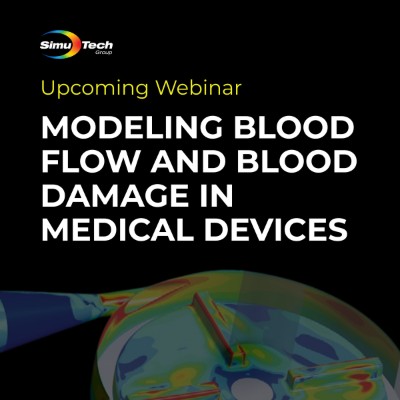
ROCHESTER, N.Y., Aug. 26, 2026 /PRNewswire/ — SimuTech Group announces the publication of a new chapter co-authored by two of its principal engineers, Mark Goodin and Ertan Taskin, in an open-access handbook on verification, validation, and uncertainty quantification (VVUQ) of computational modeling for medical devices. Their chapter focuses on blood pump simulation. Both authors will present practical applications from the chapter in a live webinar on Thursday, September 10, 2026, at 1:00 p.m. Eastern.
The chapter is one of more than 20 chapters in a volume developed under the editorial leadership of the ASME VVUQ 40 subcommittee, which develops standards for assessing the credibility of computational models used in medical device applications. Editorial contributors include Marc Horner (Ansys), Payman Afshari (Johnson & Johnson), and Jeffrey Bischoff (Zimmer Biomet). Ansys — part of Synopsys — and Johnson & Johnson funded the open-access publication to make this guidance freely available to the medical device community.
Within that volume, the Goodin-Taskin chapter discusses the methods used to establish credibility of blood pump models, with principles applicable to other blood-contacting devices, such as blood oxygenators, artificial kidneys, and dialysis equipment. It offers guidance on how simulation supports design decisions throughout the device lifecycle, from early concept exploration to regulatory submission.
A key aspect of this guidance is the complementary roles that computational simulation and physical testing play when developing new medical devices. Goodin explains:
“Early in the product development cycle, simulation is used to guide the device design. Later, when preparing your regulatory submission, test data is often the primary source of information used to establish the safety and effectiveness of new medical devices. For these cases, the risk level associated with the credibility of the computational modeling results is lower. However, when test data is not available, the reliance on the simulation results to demonstrate the safety and effectiveness of the medical device goes up. Therefore, the rigor required to demonstrate the computational model credibility goes up with it.”
Taskin, who spent a decade designing blood pumps before joining SimuTech, connects this rigor to the significance of the work:
“Every decision in medical device development carries a risk, and it carries real weight because human lives are involved. A designer has to evaluate those risks at every stage, using every available tool, simulation, and experiment, to build enough evidence for the intended function of the device.”
The chapter draws on decades of combined experience in medical device simulation.
- Mark Goodin has nearly 30 years of experience in biomedical computational fluid dynamics. He previously led the CFD simulation efforts on ventricular assist and artificial heart programs and has served for over 12 years on the ASME VVUQ 40 subcommittee.
- Ertan Taskin has more than 15 years of experience in the medical device industry, including over 10 years as the primary CFD engineer at a cardiovascular device manufacturer where he was responsible for hydraulic design and regulatory support across multiple generations of blood pump technologies. He joined SimuTech Group through its merger with Ozen Engineering.
Their work contributes to SimuTech Group’s broader medical device consulting practice. SimuTech Group has supported medical device development for over 20 years, collaborating with teams on implantables, surgical tools, diagnostics, wearables, and connected devices.
Both authors see the chapter as an entry point for engineers new to the field and as a reminder of the ultimate purpose of their work. As Goodin states: “There’s a real sense of accomplishment in contributing to a device that benefits a patient.”
This focus on real-world impact will be reflected in the September 10 webinar, which will address how blood flow and blood damage modeling support design decisions throughout the medical device lifecycle, how to establish computational model credibility, and how engineers can apply the chapter’s guidance to their own projects.
- Registration for the September 10 webinar is available at https://simutechgroup.zoom.us/webinar/register/5217871616350/WN_ojNrlsBkQ5GrZx36x9m2mg.
- The published chapter is available at https://simutechgroup.com/resources/blog/establishing-the-credibility-of-computational-models-of-blood-pumps-through-verification-validation-and-uncertainty-quantification-technical-chapter/.
- The full, open-access book is available at https://link.springer.com/book/10.1007/978-3-032-09180-2.
About SimuTech Group
SimuTech Group has over 40 years of experience helping clients push the boundaries of innovation to deliver transformational products through simulation. As the trusted advisor to more than 4,000 clients, the company supports users of Ansys simulation software — part of Synopsys — by improving product efficiency, reliability, and performance through a full-service approach spanning sales, support, consulting, and training. SimuTech’s team of engineering experts helps organizations solve complex challenges and accelerate R&D outcomes with confidence.
Contact: Aaron Smith, Director of Marketing – SimuTech Group, asmith@simutechgroup.com
 View original content to download multimedia:https://www.prnewswire.com/news-releases/simutech-group-engineers-co-author-chapter-in-open-access-medical-device-vvuq-handbook-302860701.html
SOURCE SimuTech Group Inc