
Dr. Mohana Rao Patibandla Presents Comparative Endo-TLIF vs MIS-TLIF Study at MISSABCON 2026
110-patient Guntur study examines blood loss, hospital stay, operative time, pain, disability, fusion and complications
Press Release Disclaimer: This is a press release distributed through the XPR Media network. It has not been independently verified by our newsroom.
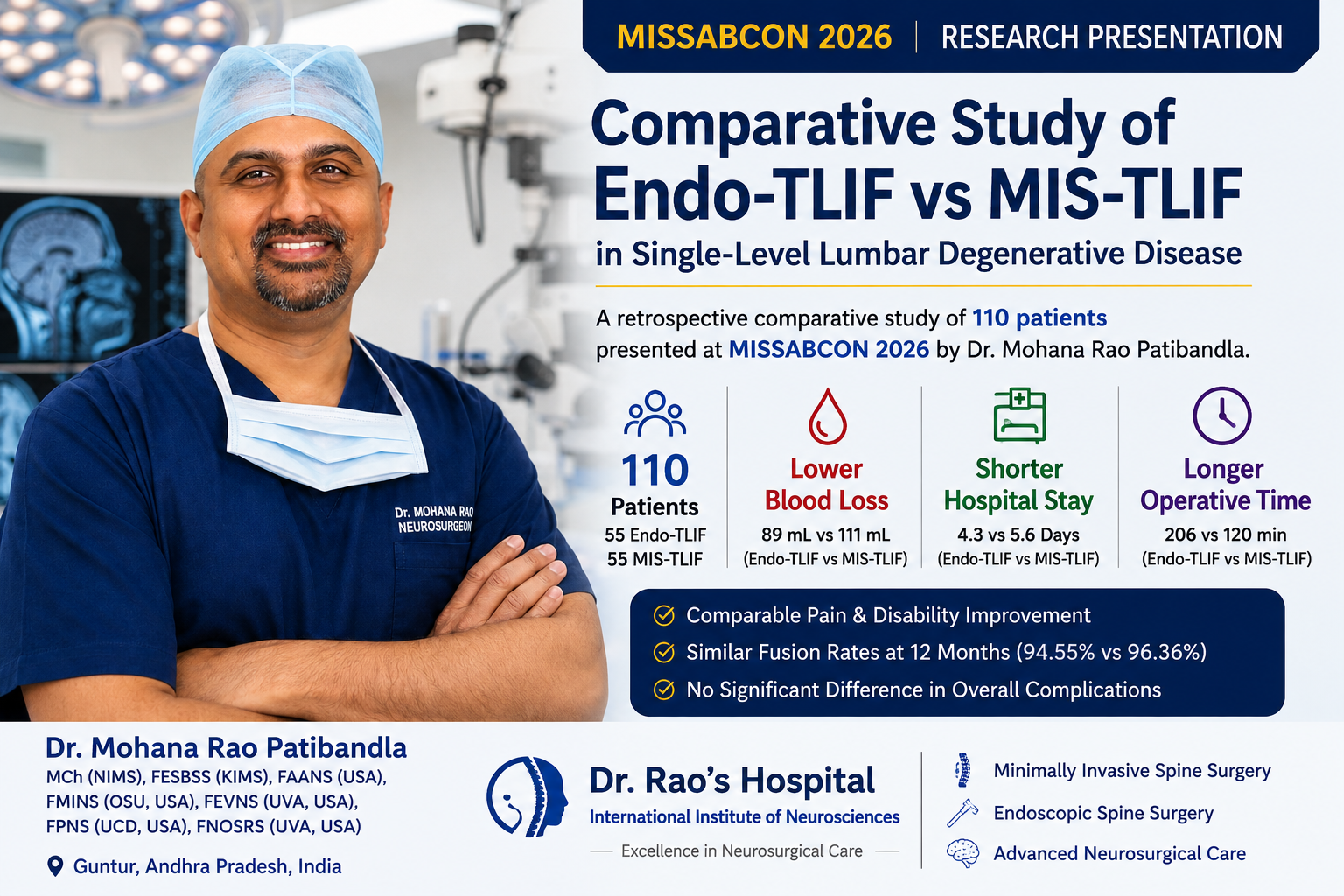

110-patient Guntur study examines blood loss, hospital stay, operative time, pain, disability, fusion and complications in minimally invasive lumbar fusion
GUNTUR, ANDHRA PRADESH, INDIA, August 18, 2026 /EINPresswire.com/ — Research from Guntur comparing two minimally invasive approaches to lumbar fusion was presented by Dr. Mohana Rao Patibandla (Dr. Rao) at MISSABCON 2026, examining clinical and radiological outcomes of endoscopic transforaminal lumbar interbody fusion (Endo-TLIF) and minimally invasive transforaminal lumbar interbody fusion (MIS-TLIF).
The retrospective comparative study included 110 patients with single-level lumbar degenerative disease, with 55 patients undergoing Endo-TLIF and 55 undergoing MIS-TLIF. The researchers evaluated perioperative, clinical and radiological outcomes.
The research addresses an increasingly important question in modern spine surgery: when two minimally invasive techniques can achieve the same fundamental surgical objective, what are the practical differences in recovery, surgical demands and outcomes?
Different Advantages and Trade-Offs
The study found that the Endo-TLIF group had significantly lower blood loss and a shorter hospital stay.
Mean blood loss was approximately 89 mL with Endo-TLIF compared with 111 mL with MIS-TLIF, while mean hospitalisation was approximately 4.3 days compared with 5.6 days, respectively.
However, the findings also demonstrated important trade-offs.
Mean operative time was significantly longer with Endo-TLIF—approximately 206 minutes compared with 120 minutes for MIS-TLIF. X-ray exposure was also higher in the Endo-TLIF group, with approximately 41 exposures compared with 27.
According to the study, both techniques produced significant improvements in pain and disability measures following surgery. Long-term clinical outcomes were comparable between the groups at the reported follow-up points.
Comparable Fusion Outcomes
Radiological assessment showed comparable results between the two groups.
At 12 months, the reported fusion rate was 94.55% for Endo-TLIF and 96.36% for MIS-TLIF, with no statistically significant difference. Other measured radiological parameters, including lumbar and segmental lordosis and disc height, also showed no significant differences between groups.
The study also found no statistically significant difference in overall complications. The reported complication rate was 9.09% in the Endo-TLIF group and 5.45% in the MIS-TLIF group.
What the Findings Mean
The research does not suggest that one minimally invasive technique is universally superior.
Instead, the findings indicate that both Endo-TLIF and MIS-TLIF can provide comparable clinical and radiological outcomes in appropriately selected patients, while having different perioperative advantages and technical demands.
The study’s conclusion states that Endo-TLIF may be considered an effective and reliable treatment option for single-level lumbar degeneration, with less trauma and faster postoperative recovery, while requiring longer operative time and greater X-ray exposure. Clinical and radiological outcomes were reported as comparable with MIS-TLIF.
“Innovation in spine surgery should be guided by evidence. The important question is not simply which technique is newer, but which approach is appropriate for the individual patient and what the available data tell us about its benefits and limitations,” said Dr. Rao.
Research-Driven Spine Surgery
The presentation reflects the increasing role of comparative clinical research in minimally invasive spine surgery. As surgeons gain access to multiple surgical approaches, systematic comparison becomes important for understanding where each technique may offer advantages.
The study presented at MISSABCON 2026 provides comparative data across blood loss, hospitalisation, operative time, radiation exposure, pain, disability, fusion and complications.
For patients, the findings reinforce the importance of individualised surgical decision-making. The appropriate procedure depends on the patient’s diagnosis, anatomy, symptoms, imaging findings, overall health and the surgeon’s assessment of the risks and expected benefits.
The research adds to the ongoing scientific discussion about how minimally invasive spine surgery can continue to evolve while maintaining attention to clinical outcomes and patient safety.
About Dr. Mohana Rao Patibandla
Dr. Mohana Rao Patibandla (Dr. Rao) is Founder, CMD and Chief Neurosurgeon of Dr. Rao’s Hospital – International Institute of Neurosciences (IIN), Guntur, Andhra Pradesh, India.
His clinical and academic interests include minimally invasive brain and spine surgery, endoscopic surgery, skull-base surgery, cerebrovascular and endovascular neurosurgery, neuro-oncology, pediatric neurosurgery, stereotactic radiosurgery and intraoperative neurophysiological monitoring.
The conference presentation lists his advanced fellowship training in minimally invasive neurosurgery and endoscopic skull-base surgery at Ohio State University, endovascular neurosurgery and neuro-oncology/radiosurgery at the University of Virginia, and pediatric neurosurgery at Nationwide Children’s Hospital and the University of Colorado.
The presentation also lists 70 national and international publications and more than 1,200 citations.
About Dr. Rao’s Hospital – International Institute of Neurosciences
Dr. Rao’s Hospital – International Institute of Neurosciences (IIN) is a specialised neuroscience centre in Guntur, Andhra Pradesh, providing care for brain, spine and nervous-system disorders, with a focus on advanced neurosurgical treatment, minimally invasive procedures and clinical research.
Media Contact
Dr. Rao’s Hospital – International Institute of Neurosciences (IIN)
Guntur, Andhra Pradesh, India
Phone: +91 90100 56444
Email: info@drraoshospitals.com
Website: https://drraoshospitals.com
Keywords: MISSABCON 2026, Endo-TLIF, MIS-TLIF, minimally invasive spine surgery, endoscopic spine surgery, lumbar fusion, lumbar degenerative disease, spine surgery research, Guntur neurosurgeon, Dr. Rao, Dr. Mohana Rao Patibandla, minimally invasive neurosurgery, endoscopic TLIF, spine innovation India
Mohana Rao Patibandla
Patibandla Narayana Swamy Neurosciences LLP
+ +91 90100 56444
email us here
Visit us on social media:
LinkedIn
Instagram
Facebook
YouTube
X
the best minimally invasive spine surgey for lumbar spine at Guntur
Legal Disclaimer:
EIN Presswire provides this news content “as is” without warranty of any kind. We do not accept any responsibility or liability
for the accuracy, content, images, videos, licenses, completeness, legality, or reliability of the information contained in this
article. If you have any complaints or copyright issues related to this article, kindly contact the author above.

Media gallery
