Robotic Arm for Space Market Expected to Reach $7.92 Billion by 2030 Driven by Robust Industry Expansion
The Business Research Company’s Robotic Arm for Space Market Global Market Report 2026 – Market Size, Trends, And
Press Release Disclaimer: This is a press release distributed through the XPR Media network. It has not been independently verified by our newsroom.

The Business Research Company’s Robotic Arm for Space Market Global Market Report 2026 – Market Size, Trends, And Forecast 2026-2035
LONDON, GREATER LONDON, UNITED KINGDOM, October 16, 2026 /EINPresswire.com/ — “The growing field of space robotics is becoming an essential part of modern space exploration and satellite operations. Among these technologies, robotic arms designed specifically for space applications are set to play a pivotal role in shaping the future of orbital missions, deep-space activities, and satellite servicing. This overview delves into the market size, regional leadership, segments, driving factors, key players, and emerging trends in the robotic arm for space industry.
Market Size and Position of Robotic Arm For Space Market
The robotic arm for space market is projected to exceed $8 billion by 2030. In comparison, its broader parent industry, the Aerospace Robotics market, is anticipated to reach roughly $9 billion by that year, with robotic arms for space accounting for about 91% of that total. Placed within the expansive Aerospace & Defense sector, which is forecasted to be worth $1,166 billion by 2030, the robotic arm segment will represent close to 1% of the overall market value.
Request A Free Sample Of The Robotic Arm For Space Market Report
https://thebusinessresearchcompany.com/sample_request?id=93551434&type=smp&name=Robotic%20Arm%20For%20Space%20Market%20Report%202026&utm_source=EINPresswire&utm_medium=Paid&utm_campaign=Oct_PR
Regional Leader in Robotic Arm For Space Market by 2030
North America is expected to dominate the robotic arm for space market in 2030, with a valuation of $3.4 billion. The market size there is forecasted to grow from $1.8 billion in 2025 at a compound annual growth rate (CAGR) of 14%. This growth is driven by increasing investments in orbital infrastructure, expanding use of robotic systems on deep-space missions, rising demand for autonomous satellite servicing capabilities, the surge of private aerospace firms entering space operations, and ongoing technological advancements that enhance mission efficiency and reliability.
Top Country in the Global Robotic Arm For Space Market by 2030
The United States will be the largest single country market for robotic arms used in space by 2030, valued at $2.9 billion. From a base of $1.5 billion in 2025, the market there is expected to grow at a 14% CAGR. Growth factors include a growing pipeline of lunar and planetary exploration projects, commercialization trends in low Earth orbit activities, robust government funding for advanced robotic platforms, increased use of robotic arms for spacecraft inspection and maintenance, and the presence of leading aerospace innovators fueling development.
Access The Detailed Robotic Arm For Space Market Report Here
https://thebusinessresearchcompany.com/report/robotic-arm-for-space-global-market-report?utm_source=EINPresswire&utm_medium=Paid&utm_campaign=Oct_PR
Dominant Segment by Type Within the Robotic Arm For Space Market
When broken down by type, the articulated robotic arm segment will lead the market in 2030, representing 42% or $3 billion of the total market value. Its popularity is owed to the superior flexibility it provides for complex multi-axis movements, which are crucial for satellite capture, docking, orbital assembly, and servicing missions. Additionally, its ability to operate adeptly in confined space environments and ongoing improvements in precision and autonomous function support this dominance.
Market Segmentation Across Payload, Application, and End Users
The robotic arm for space market is also divided by payload capacity into low, medium, and high categories. By applications, it serves satellite servicing, space station maintenance, cargo handling, assembly tasks, and other specialized uses. From an end-user perspective, the market caters to government space agencies, commercial space enterprises, research organizations, and other customers engaged in space missions.
Growth Rate and Market Expansion Forecast
The robotic arm for space market is predicted to grow at a strong CAGR of 14% leading up to 2030, reflecting robust market demand and technological advancements.
Primary Factors Propelling Growth in the Robotic Arm For Space Market
One major driver behind this market’s rapid expansion is the surge in investments targeted at space exploration and orbital infrastructure. Both public and private sectors are dedicating significant resources toward lunar missions, deep-space exploration, orbital stations, and next-generation spacecraft. Robotic arms play a vital role in construction, equipment manipulation, and mission-critical operations in difficult space environments. The ongoing focus on establishing a sustained human and robotic presence in space is raising demand for innovative robotic manipulation technologies, contributing an estimated 3% annual growth to the market.
Rising Need for On-Orbit Satellite Servicing and Maintenance
Another key factor boosting market growth is the increasing demand for on-orbit satellite servicing and maintenance. Operators seek cost-effective methods to extend satellite lifespans, reduce replacement expenses, and enhance operational efficiency. Robotic arms enable tasks such as inspection, repairs, refueling, repositioning, and component swaps without requiring full satellite replacement. As the value of orbital assets grows and mission returns become more critical, adoption of robotic servicing solutions is accelerating, expected to add around 2.5% annual growth.
Influence of Expanding Commercial Satellite Constellations
The deployment of commercial satellite constellations is also fueling demand for robotic arms in space. Networks for communication, navigation, Earth observation, and broadband connectivity become increasingly complex, requiring robotic systems for assembly, deployment, and operational management. These technologies reduce mission risks, enhance flexibility, and support the increasing volume of satellites launched into orbit. This trend is projected to contribute approximately 2.3% annual growth to the market.
Key Growth Opportunities Across Robotic Arm Types
Significant opportunities are emerging across various robotic arm types including articulated, selective compliance articulated robot arms, Cartesian, cylindrical, polar, and other classifications. Collectively, these segments are anticipated to generate over $4.9 billion in market value by 2030. Growth is driven by increasing needs for autonomous robotic operations in space, the growing complexity of servicing and assembly missions, expanded use for spacecraft handling and inspection, rising investments in next-generation space infrastructure, and continuous improvements in precision control, sensing, and autonomous navigation technologies. This development reflects the space industry’s focus on improving mission outcomes, reducing risks, and enabling long-term orbital activities.
Segment Growth Projections Between 2025 and 2030
From 2025 to 2030, the articulated segment is expected to grow by $2 billion, the selective compliance articulated robot arm by $1 billion, Cartesian by $1 billion, cylindrical by $0.4 billion, polar by $0.3 billion, and other types by $0.2 billion. The market features a mixture of well-established aerospace technology firms and specialized space robotics developers focusing on autonomous manipulation, precision motion control, modular designs, AI integration, and enhanced sensing. Emphasis remains on operational reliability in harsh space conditions, precision maneuverability, adaptability, efficient payload handling, and compliance with rigorous space standards.
Leading Company Guiding the Robotic Arm For Space Market
Research shows that MDA Space Ltd. led global sales in 2025 with a 3% market share. MDA’s space robotics division offers a comprehensive portfolio of robotic manipulation systems, autonomous platforms, in-orbit servicing technologies, and mission-critical infrastructure supporting satellite operations, orbital maintenance, cargo handling, and advanced space exploration activities across government and commercial sectors.
Top Players Shaping the Robotic Arm For Space Industry
Key companies actively operating in this specialized market include MDA Space Ltd., Northrop Grumman Corporation, Intuitive Machines, Inc. (Lanteris, formerly Maxar Space Systems), Airbus SE, Thales Alenia Space, Redwire Corporation, Honeybee Robotics, Oceaneering International Inc., Leonardo S.p.A., Mitsubishi Electric Corporation, China Academy of Space Technology, GITAI Inc., Motiv Space Systems Inc., Astrobotic Technology Inc., ClearSpace SA, SENER Grupo de Ingeniería S.A., Space Applications Services NV/SA, Lunar Outpost Inc., Kawasaki Heavy Industries Ltd., PIAP Space Sp. z o.o., Lodestar Space Ltd., Rovial Space Inc., Astrabionics Inc., and Novium Inc.
Market Concentration and Competitive Landscape
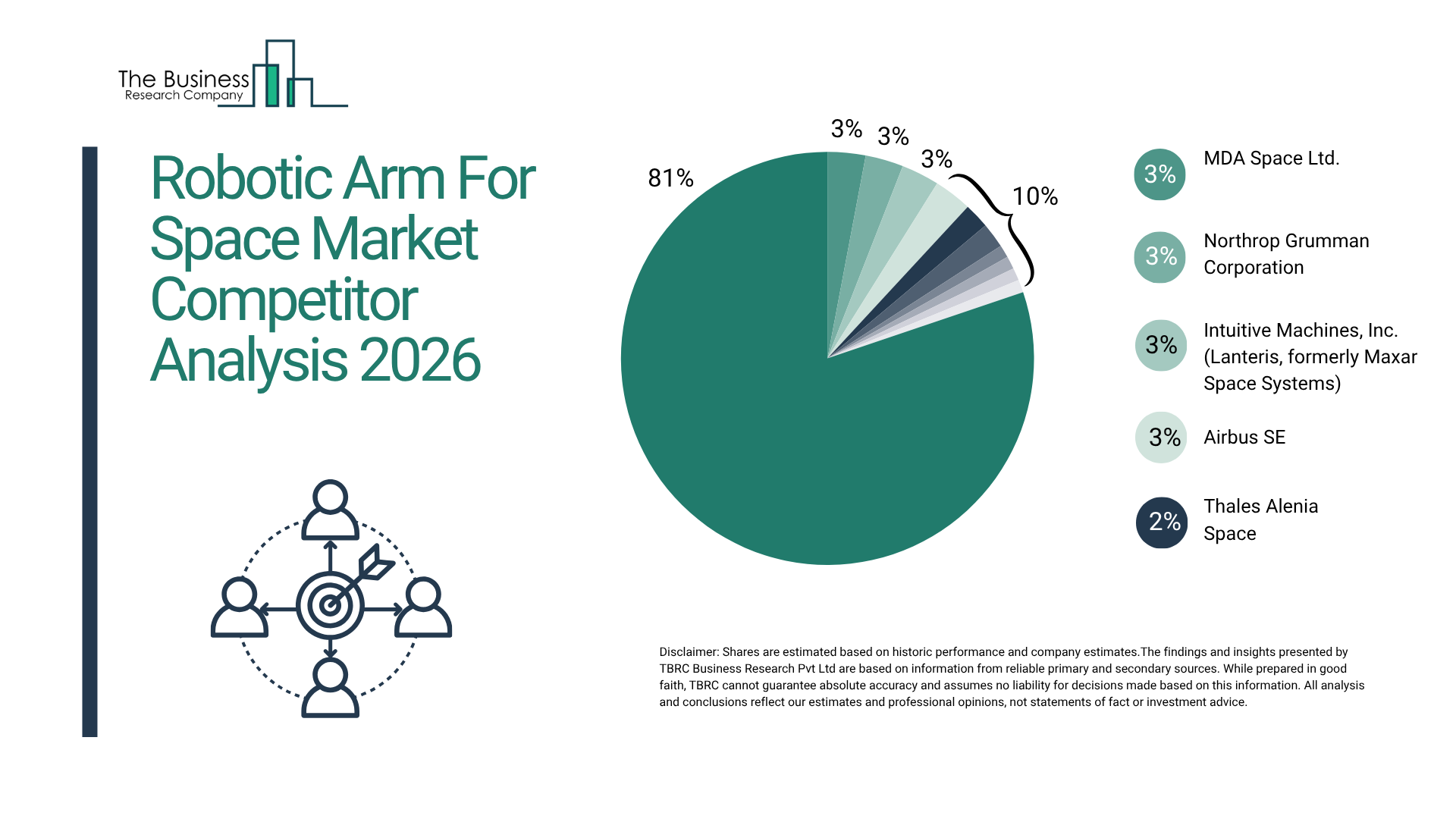
The robotic arm for space market is moderately fragmented, with the top 10 players holding about 19% of total revenue in 2025. This balance reflects significant technological and operational entry barriers due to the complexity of space-grade robotics, stringent reliability requirements, rigorous testing, and specialized engineering expertise for orbital and deep-space applications. Leading firms maintain their market shares through advanced robotics capabilities, longstanding government and commercial program participation, proprietary technologies, and extensive experience in spacecraft servicing and orbital operations. As demand rises for autonomous space operations, satellite life-extension services, lunar exploration, and commercial orbital infrastructure, investments in technology, strategic partnerships, and new applications will further consolidate their positions.
Prominent companies and their estimated market shares in 2025 include:
– MDA Space Ltd. (3%)
– Northrop Grumman Corporation (3%)
– Intuitive Machines, Inc. (Lanteris) (3%)
– Airbus SE (3%)
– Thales Alenia Space (2%)
– Redwire Corporation (2%)
– Honeybee Robotics (1%)
– Oceaneering International Inc. (1%)
– Leonardo S.p.A. (1%)
– Mitsubishi Electric Corporation (1%)
Key Raw Material Suppliers Supporting the Market
Major suppliers providing essential raw materials to the robotic arm for space market include 3M Company, Toray Industries Inc., Hexcel Corporation, Teijin Limited, Solvay SA, Mitsubishi Chemical Group Corporation, Carpenter Technology Corporation, ATI Inc., Materion Corporation, Kennametal Inc., CoorsTek Inc., CeramTec GmbH, Parker Hannifin Corporation, Harmonic Drive Systems Inc., Moog Inc., Maxon Group, Renishaw plc, TE Connectivity Ltd., and Amphenol Corporation.
Important Wholesalers and Distributors in the Market
The distribution network for robotic arm components involves major wholesalers and distributors such as Avnet Inc., Arrow Electronics Inc., WPG Holdings Limited, TTI Inc., Future Electronics Inc., Mouser Electronics Inc., DigiKey Electronics, RS Group plc, Farnell Global, Rutronik Elektronische Bauelemente GmbH, Heilind Electronics Inc., Powell Electronics Inc., Electro Enterprises Inc., PEI-Genesis Inc., Sager Electronics Inc., Fusion Worldwide, Astute Electronics Ltd., and EBV Elektronik GmbH & Co. KG, Macnica Holdings Inc.
Primary End Users of Robotic Arm For Space Technologies
Key end users in this market include prominent government space agencies and commercial operators such as the National Aeronautics and Space Administration (NASA), European Space Agency (ESA), Japan Aerospace Exploration Agency (JAXA), Canadian Space Agency (CSA), Indian Space Research Organisation (ISRO), China National Space Administration (CNSA), Korea AeroSpace Administration (KASA), United Arab Emirates Space Agency, Roscosmos State Corporation, Saudi Space Agency, as well as private companies like SpaceX, Blue Origin LLC, Eutelsat OneWeb, SES S.A., Intelsat S.A., Telesat Corporation, Planet Labs PBC, and Rocket Lab Corporation.
Transformative Trends in the Robotic Arm For Space Market
The emergence of in-space servicing, assembly, and manufacturing (ISAM) technologies is revolutionizing the robotic arm market by enabling autonomous orbital operations, extending spacecraft lifespans, and supporting next-generation space infrastructure development. For example, in January 2024, GITAI USA Inc. deployed its 1.5-meter autonomous dual robotic arm system, known as S2, aboard SpaceX’s Falcon 9 NG-20 mission to the International Space Station. This system’s autonomous manipulation, proprietary tool-changing mechanism, and ability to perform satellite servicing, assembly, inspection, and on-orbit manufacturing demonstrate how robotic arms are enhancing operational efficiency, reducing costs, and accelerating adoption for complex space missions.
Strategies Adopted by Companies to Maintain Market Leadership
Leading firms in this sector prioritize developing autonomous robotic systems that improve on-orbit servicing capabilities and integrate artificial intelligence to enhance mission precision and reliability. They focus on modular robotic arm designs for orbital assembly and actively pursue strategic partnerships to foster commercial space robotics innovations. Investments in technologies aimed at supporting lunar exploration and deep-space missions further strengthen their competitive edge.
In summary, the robotic arm for space market is on a strong growth trajectory, driven by increasing investments in space exploration, demand for satellite servicing, and the deployment of commercial satellite constellations. With key segments expanding rapidly and a mix of established and emerging players advancing technology and operational capabilities, the industry is set to play a critical role in the future of space missions and infrastructure development.
New additions to our 2026 reports:
• Market attractiveness scoring and analysis
• Total addressable market (TAM) analysis
• Company scoring matrix graphics and tables
• Excel-based forecasting dashboards
• Market hotspots infographics
• Key technologies and future trend analysis
• Updated graphics and tables
Learn More About The Business Research Company
The Business Research Company (www.thebusinessresearchcompany.com) is a leading market intelligence firm renowned for its expertise in company, market, and consumer research. We have published over 30,000+ reports across 27 industries and 60+ geographies. Our research is powered by 1,500,000 datasets, extensive secondary research, and exclusive insights from interviews with industry leaders.
We provide continuous and custom research services, offering a range of specialized packages tailored to your needs, including Market Entry Research Package, Competitor Tracking Package, Supplier & Distributor Package and much more.
Disclaimer: Please note that the findings, conclusions and recommendations that TBRC Business Research Pvt Ltd delivers are based on information gathered in good faith from both primary and secondary sources, whose accuracy we are not always in a position to guarantee. As such TBRC Business Research Pvt Ltd can accept no liability whatever for actions taken based on any information that may subsequently prove to be incorrect. Analysis and findings included in TBRC reports and presentations are our estimates, opinions and are not intended as statements of fact or investment guidance.
Contact Us:
The Business Research Company
Americas +1 310-496-7795
Europe +44 7882 955267
Asia & Others +44 7882 955267 & +91 8897263534
Email: marketing@tbrc.info
Follow Us On:
LinkedIn: https://in.linkedin.com/company/the-business-research-company“
Oliver Guirdham
The Business Research Company
+44 7882 955267
info@tbrc.info
Visit us on social media:
LinkedIn
Facebook
X
Legal Disclaimer:
EIN Presswire provides this news content “as is” without warranty of any kind. We do not accept any responsibility or liability
for the accuracy, content, images, videos, licenses, completeness, legality, or reliability of the information contained in this
article. If you have any complaints or copyright issues related to this article, kindly contact the author above.

Media gallery