Sugar Free Ice Cream Market Driven by Healthier Dessert Demand to Reach USD 34.02 Billion by 2035 at 5.45% CAGR
Health-focused consumers, alternative sweeteners, protein, and convenient formats are reshaping the sugar free ice
Press Release Disclaimer: This is a press release distributed through the XPR Media network. It has not been independently verified by our newsroom.

Health-focused consumers, alternative sweeteners, protein, and convenient formats are reshaping the sugar free ice cream market through 2035.
NEW YORK, NY, UNITED STATES, August 28, 2026 /EINPresswire.com/ —
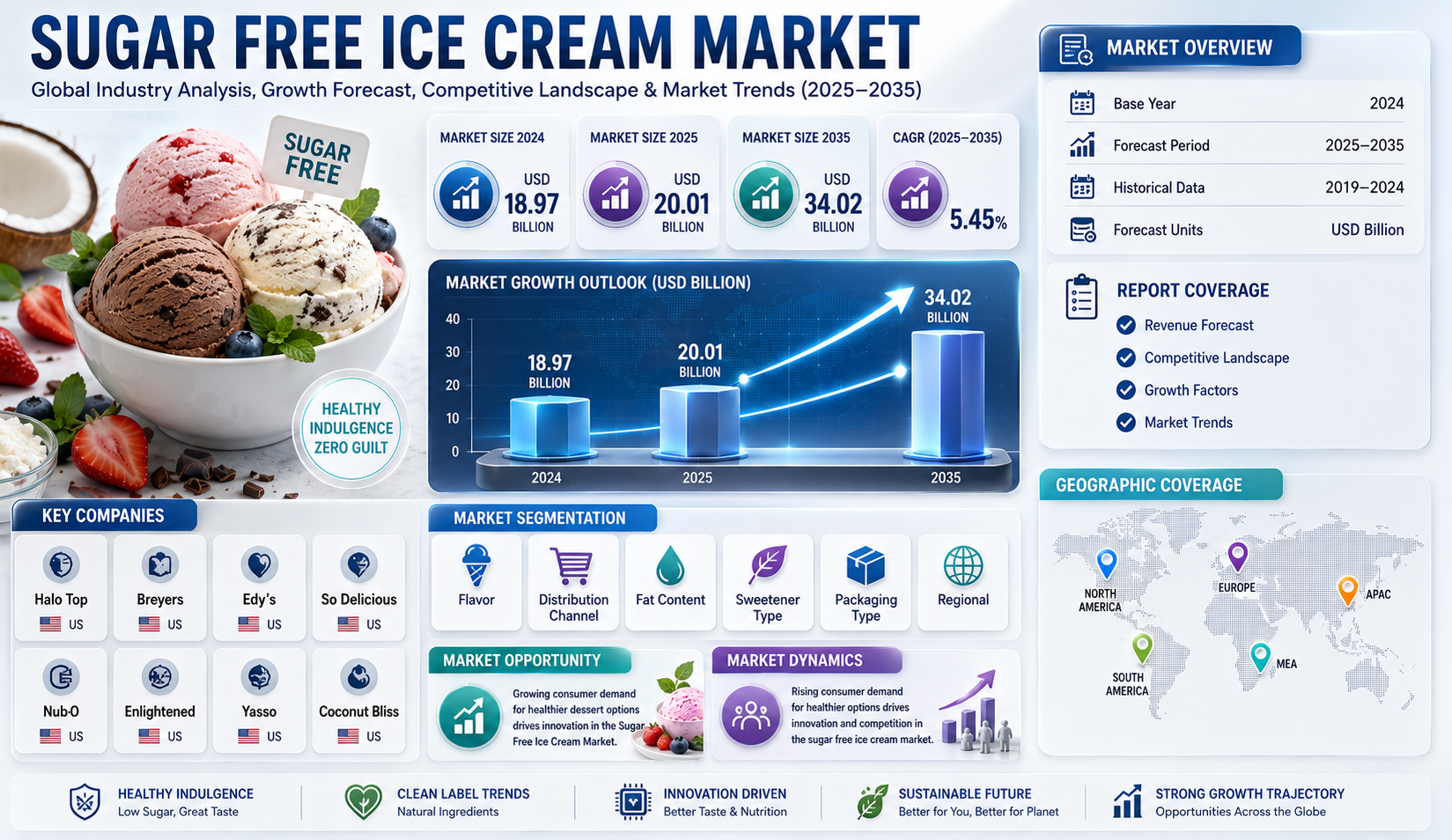
The global Sugar Free Ice Cream Market is entering a period of sustained expansion as consumers increasingly seek desserts that balance indulgence with nutritional considerations. The market is projected to increase from USD 18.97 billion in 2024 to USD 20.01 billion in 2025, reaching USD 34.02 billion by 2035, at a 5.45% CAGR from 2025 to 2035. The market analysis covers historical data from 2019–2024 and forecasts revenue through 2035. The central growth factor is the rising consumer preference for healthier dessert options, particularly products with reduced sugar, alternative sweeteners, lower calories, higher protein, and specialized dietary positioning.
Competitive activity is also intensifying as established and emerging brands attempt to combine traditional ice-cream sensory characteristics with health-oriented formulations. Halo Top, Breyers, Edy’s, So Delicious, NubO, Enlightened, Yasso, and Coconut Bliss are among the key companies profiled in the market. Competition increasingly extends beyond sugar reduction to include protein content, plant-based formulations, premium ingredients, portion control, flavor innovation, and convenient packaging. Halo Top, for example, has continued expanding its better-for-you positioning, including mix-in products introduced in 2025.
The market is consequently evolving from a niche dietary category into a broader frozen-dessert segment. Consumers are no longer necessarily seeking sugar-free products solely because of dietary restrictions; instead, reduced sugar and alternative sweetening are becoming components of a wider wellness-oriented purchasing decision. Regulatory attention to sugar labeling also supports greater consumer awareness. In the U.S., the FDA distinguishes total sugars from added sugars and requires added sugars to be declared on Nutrition Facts labels.
Free Sample Copy – Access A Complimentary Copy of Our Report to Explore Its Content and Insights
https://www.marketresearchfuture.com/sample_request/24520
Key Market Drivers and Trends
The strongest market driver is the growing demand for healthier alternatives to conventional desserts. Consumers are increasingly examining sugar, calorie, fat, protein, and ingredient labels when selecting frozen treats. This is encouraging manufacturers to reformulate products without sacrificing creaminess, sweetness, mouthfeel, or flavor intensity. The use of high-intensity sweeteners and sugar substitutes such as stevia, monk fruit, sucralose, and other alternatives enables manufacturers to reduce conventional sugar while maintaining sweetness. The FDA notes that certain high-intensity sweeteners provide few or no calories and are widely used in foods marketed as sugar-free or diet products.
Another important trend is the convergence of sugar reduction and functional nutrition. Protein-enriched, fiber-containing, low-calorie, and plant-based frozen desserts are broadening the definition of healthier ice cream. This creates opportunities for products targeting active consumers, weight-conscious shoppers, and consumers seeking convenient snacks rather than conventional after-meal desserts. Recent product launches demonstrate how protein and reduced sugar are increasingly being combined within frozen formats.
Segment Analysis
By Flavor
Flavor remains a critical competitive factor because sugar reduction can affect sweetness perception and overall sensory performance. Vanilla and chocolate continue to provide broad consumer appeal and serve as important platforms for reformulation. Fruit-based flavors such as strawberry and other berry varieties provide opportunities for brands seeking a lighter sensory profile, while premium combinations such as salted caramel, cookie-inspired flavors, coffee, and chocolate inclusions support indulgent positioning.
The flavor segment is therefore shifting toward combinations that compensate for the perceived limitations of sugar-free formulations. Mix-ins, sauces, fruit pieces, nuts, and chocolate inclusions can enhance texture and perceived indulgence. Halo Top’s expansion into mix-in varieties illustrates this movement toward richer sensory experiences within better-for-you frozen desserts.
By Distribution Channel
Distribution is divided broadly between offline and online channels. Supermarkets and hypermarkets remain important because frozen desserts require refrigeration infrastructure and benefit from high-traffic freezer placement. Convenience stores and specialty food retailers provide additional opportunities for individually portioned products and premium alternatives.
Online distribution is becoming increasingly relevant because consumers can discover specialized dietary products that may have limited physical-store availability. Direct-to-consumer platforms, online grocery services, and brand websites also enable manufacturers to communicate nutritional attributes and product differentiation more extensively.
By Fat Content
The market can be categorized into low-fat, reduced-fat, and regular/high-fat formulations. Low-fat products appeal to consumers seeking calorie control and lighter desserts, while regular-fat formulations can provide the creamy mouthfeel traditionally associated with premium ice cream.
This creates a formulation trade-off. Reducing both sugar and fat can affect body, texture, and flavor release, requiring manufacturers to use fibers, proteins, stabilizers, or alternative sweetening systems. Consequently, some premium sugar-free products retain relatively higher fat levels while emphasizing carbohydrate or sugar reduction rather than overall calorie minimization.
By Sweetener Type
Sweetener selection represents one of the most technologically important segments. Stevia, monk fruit, erythritol, allulose, sucralose, and other sweetening systems are used according to desired sweetness intensity, calorie profile, taste, labeling requirements, and formulation compatibility.
Allulose is attracting particular attention because it behaves differently from conventional sugars and has specific implications for nutrition labeling in the U.S. The FDA states that allulose must be included in total carbohydrates but may be excluded from total and added sugars under specified labeling treatment.
The challenge is balancing sweetness with aftertaste and texture. A single sweetener may not reproduce the functionality of sucrose, encouraging manufacturers to combine sweeteners and bulking ingredients. This makes sweetener innovation a major area of product-development competition.
By Packaging Type
Packaging includes pints, cups, tubs, bars, sandwiches, and other single-serve formats. Pints remain important for household consumption, while smaller formats support portion control and impulse purchasing. Bars and pops are particularly suited to convenience-oriented consumers.
The expansion of protein and reduced-sugar frozen desserts into portable formats indicates that packaging is becoming part of product differentiation rather than simply a containment function. In 2026, Protein Pints introduced Protein Pops containing 10 grams of protein per bar and positioning them as a convenient frozen novelty format.
By Region
North America represents a major innovation center because of strong consumer interest in low-calorie, low-sugar, high-protein, and functional frozen desserts. The region also has an established competitive environment involving both specialist and mainstream brands.
Europe offers opportunities linked to clean-label preferences, ingredient transparency, premiumization, and dietary-conscious consumption. Manufacturers are increasingly required to balance nutritional positioning with consumer expectations around ingredient quality.
Asia Pacific presents significant long-term potential because of population scale, urbanization, expanding retail infrastructure, and changing food preferences. Local flavor profiles can provide opportunities for differentiated sugar-free formulations.
South America is supported by expanding modern retail and growing interest in differentiated packaged foods, while Middle East and Africa (MEA) provide opportunities through urbanization, premium retail development, and demand for diversified frozen-dessert products.
Competitive Landscape
Competition is centered on product reformulation, taste improvement, nutritional differentiation, brand positioning, and distribution expansion. Halo Top has built its identity around lighter ice cream and has continued to introduce more indulgent formats. Yasso has expanded beyond traditional frozen Greek yogurt bars into spoonable products, with current offerings providing up to 19 grams of protein per container.
Breyers, Edy’s, So Delicious, Enlightened, NubO, Coconut Bliss, and other participants compete across different combinations of dairy, plant-based, low-fat, protein-oriented, and reduced-sugar positioning. The competitive environment increasingly favors companies capable of delivering both health credentials and conventional ice-cream eating quality.
Industry Developments
1. Protein-focused frozen dessert expansion: In June 2026, David launched its Frozen Dessert line with four pint flavors, delivering 30 grams of protein per pint, 210–260 calories, and less than 1–2 grams of sugar. The company reported that the products sold out online within 28 minutes, highlighting strong interest in high-protein frozen formats.
2. Expansion into portable reduced-sugar formats: In June 2026, Protein Pints launched Protein Pops, extending its portfolio from pints into chocolate-dipped bars. The products contain 10 grams of complete protein and at least 75% less sugar than traditional ice cream, demonstrating the industry’s movement toward portable, portion-controlled and nutritionally differentiated formats.
Future Outlook
The Sugar Free Ice Cream Market is expected to maintain steady growth through 2035 as healthier eating habits increasingly influence discretionary food purchases. The projected rise from USD 20.01 billion in 2025 to USD 34.02 billion by 2035, representing a 5.45% CAGR, indicates that sugar reduction is becoming a structural product-development theme rather than a temporary trend.
Future competition will likely focus on improving the relationship between nutrition and indulgence. Manufacturers that can reduce sugar while preserving creaminess, flavor intensity, texture, and affordability will be better positioned to capture mainstream consumers. At the same time, alternative sweeteners, protein enrichment, plant-based bases, portion-controlled formats, and premium flavors are expected to create additional avenues for differentiation.
The market’s long-term opportunity therefore extends beyond the traditional definition of “sugar-free.” It increasingly encompasses better-for-you frozen desserts designed around consumers’ broader expectations for nutrition, convenience, sensory quality, and ingredient transparency.
FAQs
1. What is driving the Sugar Free Ice Cream Market?
The primary driver is rising consumer demand for healthier dessert options, supported by interest in lower sugar, alternative sweeteners, calorie management, protein enrichment, and specialized dietary products.
2. What is the projected size of the Sugar Free Ice Cream Market by 2035?
The market is projected to reach USD 34.02 billion by 2035, expanding at a 5.45% CAGR from 2025 to 2035.
Read Our Related Research Report
Sugar Free Beverage Market –
https://www.marketresearchfuture.com/reports/sugar-free-beverage-market-3869
Sugar-Free Confectionery Market –
https://www.marketresearchfuture.com/reports/sugar-free-confectionery-market-4950
Sugar-Free Chewing Gum Market –
https://www.marketresearchfuture.com/reports/sugar-free-chewing-gum-market-10400
Sagar Kadam
Market Research Future
+1 628-258-0071
email us here
Legal Disclaimer:
EIN Presswire provides this news content “as is” without warranty of any kind. We do not accept any responsibility or liability
for the accuracy, content, images, videos, licenses, completeness, legality, or reliability of the information contained in this
article. If you have any complaints or copyright issues related to this article, kindly contact the author above.

Media gallery