Telemedicine Market to reach USD 479.67 Billion by 2035 at 14.18% CAGR
Telemedicine Market to Surge from USD 123.28 Bn in 2025 to USD 479.67 Bn by 2035- Reimbursement Parity Codification,
Press Release Disclaimer: This is a press release distributed through the XPR Media network. It has not been independently verified by our newsroom.
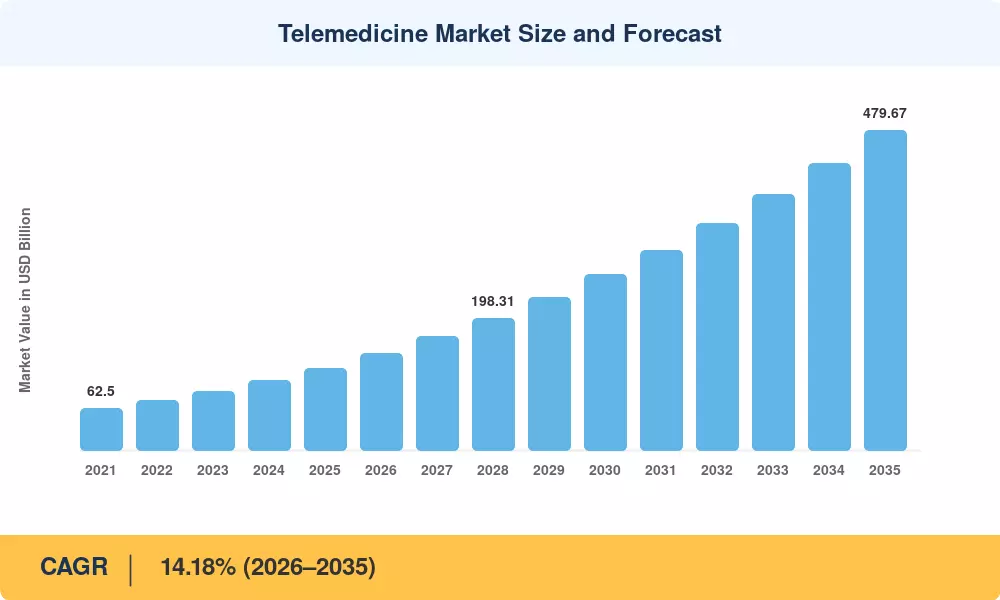

Telemedicine Market to Surge from USD 123.28 Bn in 2025 to USD 479.67 Bn by 2035- Reimbursement Parity Codification, Employer-Sponsored Virtual Primary Care
NY, CA, UNITED STATES, September 9, 2026 /EINPresswire.com/ — As per Market Research Future, the global Telemedicine Market size is projected to reach USD 479.67 Billion by 2035 from USD 123.28 Billion in 2025, at a CAGR of 14.18% during the forecast period 2025–2035. The market base was estimated at approximately USD 108.5 Billion in 2024.
The 14.18% CAGR—anchored by structural shifts in digital health delivery—is propelled by three converging forces: the codification of reimbursement parity statutes across 43 U.S. states and permanent Medicare behavioural telehealth provisions, converting pandemic-era waivers into codified payment law and giving the Telemedicine Market a recurring revenue base rather than an episodic one; the migration of employer-sponsored virtual primary care contracts from pilot budgets into core benefits spending, alongside the expansion of remote patient monitoring reimbursement under chronic-care management codes; and the substitution of legacy fax-driven referral procedures with API-native technologies that write structured encounter data directly into electronic health records, supported by the U.S. TEFCA framework and expanding 5G standalone coverage to approximately 62% of metropolitan populations globally.
Global telehealth platform providers and health technology organizations are amplifying this momentum. Teladoc Health maintains the broadest enterprise payer footprint with an estimated 8–11% global revenue share. Ping An Healthcare and Technology dominates the China market through its insurer-integrated internet hospital model. Amwell continues strengthening its hospital-branded virtual care platform through the Converge suite, while Philips extended its tele-ICU platform with predictive deterioration analytics in early 2025. According to CMS data, permanent Medicare behavioural telehealth provisions now cover roughly 68 million beneficiaries, while the FCC’s Rural Health Care programme disbursed over USD 570 million in connectivity subsidies during 2025. These forces are creating the regulatory infrastructure and enterprise demand on which the Telemedicine Market depends.
Request A Free Sample:
https://www.marketresearchfuture.com/sample_request/2216
Key Market Trends & Growth Drivers
Reimbursement Parity Codification
The market is witnessing accelerating demand driven by payment certainty rather than technology alone. The Consolidated Appropriations Act extensions and subsequent Medicare Physician Fee Schedule rulemaking made behavioural telehealth permanent and preserved geographic-originating-site flexibility, covering roughly 68 million beneficiaries. Commercial parity mandates in 43 states now require payers to reimburse remote encounters at in-person rates for equivalent CPT codes. Health systems responded by shifting an estimated USD 4.1 billion of 2025 capital budgets toward permanent virtual-care infrastructure rather than leased pandemic stopgaps.
Employer-Sponsored Virtual Primary Care
Employer-sponsored virtual primary care contracts have moved from pilot budgets into core benefits spending, giving the Telemedicine Market a recurring revenue base rather than an episodic one. Payers and employers increasingly dictate platform selection through preferred-vendor arrangements that cover tens of millions of lives. Per-member-per-month pricing with utilisation floors protects vendors, while outcome-linked holdbacks of 10–15% protect buyers.
Advancements in AI-Enabled Clinical Decision Support
Innovations in clinical intelligence are becoming a hallmark of the industry. Ambient documentation tools now cut clinician charting time by an average of 43 minutes per shift in deployed health-system studies, and FDA has cleared more than 1,000 AI-enabled medical devices cumulatively, many with remote-review indications. By 2030, roughly 40% of first-contact encounters are expected to be routed by AI triage engines with clinician oversight, compressing average time-to-appropriate-care from 38 hours to under 6.
Integration of Remote Patient Monitoring and Hospital-at-Home
The incorporation of continuous remote monitoring into acute and chronic care is gaining traction. Approved home-hospital programmes have grown past 380 participating U.S. facilities, and per-episode costs run 22–29% below inpatient equivalents. Remote monitoring reimbursement under CPT 99453–99458 has grown claim volumes at double-digit rates for four consecutive years. Platforms that combine continuous monitoring with escalation logic and logistics orchestration capture a far higher contract value than consultation-only vendors.
Ageing Demographics and Chronic Care Load
Populations aged 65 and over will expand from roughly 830 million to more than 1.1 billion by 2035, and this cohort accounts for close to 61% of chronic-condition management spending in OECD systems. Payers increasingly treat continuous physiologic data as a substitute for scheduled office visits, which restructures the entire encounter economy and drives sustained demand for telemedicine infrastructure.
Ask for Customization:
https://www.marketresearchfuture.com/ask_for_customize/2216
Market Segment Insights
BY MODALITY
Synchronous: Largest segment with 41.2% share in 2025, reflecting entrenched payer familiarity with real-time encounter codes and behavioural health volume. Teladoc Health continues expanding synchronous virtual primary care through broadest enterprise payer footprint.
Remote Patient Monitoring: Fastest-growing segment, scaling at a 15.89% CAGR through 2035 as chronic-care management codes broaden and average annual contract value per enrolled patient sits between USD 480 and USD 720.
Asynchronous (Store-and-Forward): Generated USD 38.83 billion in 2025, concentrated in dermatology and radiology specialist backlog relief.
BY COMPONENT
Services and Support: Largest segment, capturing 52.8% of spend in 2025, driven by clinician staffing, integration, and managed operations. Health systems buy outcomes, not licences, and clinician supply is the scarce input.
Software Platforms: Fastest-growing component, advancing at a 15.10% CAGR as health systems replace fragmented point solutions with unified suites. A typical large system ran 14 separate virtual-care tools in 2023 and targets fewer than 5 by 2027.
Hardware & Peripherals: Valued at USD 20.71 Billion in 2025, driven by connected diagnostic kits and monitoring devices.
BY END USER
Healthcare Providers: Largest segment with 51.4% share in 2025, due to capacity extension needs and referral network control. Providers anchor spending because they control referral flow and carry clinical liability.
Payers & Employers: Significant share at USD 27.86 Billion in 2025, driven by cost avoidance and benefits differentiation through preferred-vendor arrangements.
Patients / Home Users: Fastest-growing end-user segment, expanding at a 13.89% CAGR, as direct-pay convenience and subscription models gain traction among tech-savvy consumers.
BY SPECIALTY
Telepsychiatry: Fastest-growing specialty, tracking a 16.94% CAGR to 2035, reflecting acute workforce shortages against measurable outcome data and permanent Medicare behavioural health provisions.
Emergency Services: Significant share, driven by virtual triage and emergency department diversion programmes.
Dermatology: Established store-and-forward vertical with proven payer willingness and outcome measurement tractability.
Read Detailed Insights:
https://www.marketresearchfuture.com/reports/telemedicine-market-2216
Regional Outlook
North America — Market Leader in Innovation
North America leads with 35.4% of global revenue in 2025, generating around USD 43.64 Billion. The region’s growth is driven by Medicare permanence for behavioural telehealth, state parity statutes in 43 states, and the FCC’s Rural Health Care programme which disbursed over USD 570 million in connectivity subsidies during 2025. The competitive landscape is characterized by continuous platform consolidation and strategic partnerships among leading telehealth vendors.
Europe — Second Largest Market
Europe was valued at USD 33.04 billion in 2025, representing the second-largest regional market. The region benefits from Germany’s DiGA reimbursement pathway with over 1.1 million cumulative prescribed digital application activations, and the European Health Data Space regulation entering phased application through 2029. Leading countries include Germany, the UK, and France, where major health technology vendors such as Philips and GE HealthCare are heavily invested.
Asia-Pacific — Rapidly Growing Market Segment
The Asia-Pacific region is the fastest-growing market, posting a 18.22% CAGR through 2035. The growth is driven by China’s licensed internet hospitals surpassing 3,300 facilities with provincial insurance settlement enabled, India’s eSanjeevani service logging more than 340 million cumulative consultations under the Ayushman Bharat Digital Mission, and Japan’s online medical care fee revisions for elderly cohorts. The competitive landscape is evolving with companies like Ping An Healthcare and Practo leading the charge.
South America — Expanding Regulatory Framework
South America was valued at USD 6.41 Billion in 2025. Brazil’s Law 14.510 converted emergency telemedicine authorisation into permanent legal footing, and private supplementary insurers covering roughly 51 million lives now drive the majority of commercial volume. Argentina and other markets are seeing ministry-led rural connectivity projects accelerate adoption.
Middle East and Africa — Untapped Potential
The MEA region holds around 5.5% of the global share, driven by sovereign virtual-hospital programmes and rising healthcare investments. Saudi Arabia’s Seha Virtual Hospital connects more than 170 facilities and handles referrals across 44 specialties, functioning as a national tertiary backstop. The UAE’s Malaffi and Riayati health information exchanges are leading digital health transformation, while sub-Saharan deployments in Kenya, Ghana, and Rwanda are producing durable primary-care infrastructure.
Competitive Landscape and Recent Developments
The telemedicine market is characterized by intense competition and rapid growth, driven by reimbursement maturation and technology substitution worldwide. The global industry appears moderately fragmented, with the top five players accounting for about 29–33% of global sales and an estimated HHI of about 440.
KEY COMPANIES AND RECENT MILESTONES
Teladoc Health (US): Holds an estimated 8–11% global revenue share. Maintains the broadest enterprise payer footprint across virtual primary care, chronic care management, and behavioural health.
Ping An Healthcare and Technology (CN): Holds an estimated 6–9% global revenue share. Dominant China insurer-integrated model spanning internet hospital, insurance-linked consultation, and pharmacy services.
Amwell (US) (January 2024): Advanced the Digital First initiative with the U.S. Defense Health Agency to extend virtual care across military treatment facilities serving roughly 9.6 million beneficiaries. Continues strengthening hospital-branded virtual care through the Converge platform.
Philips (NL) (February 2025): Extended its tele-ICU platform with predictive deterioration analytics for community hospital networks, reinforcing its hospital-grade clinical infrastructure positioning.
Hims & Hers Health (US) (May 2025): Launched integrated lab testing tied to subscription care plans, deepening its consumer diagnostic loop and pharmacy vertical integration.
Other Key Players: Included Health (US), Evernorth / MDLIVE (US), GE HealthCare (US), Medtronic (IE), Doximity (US), Practo (IN).
Future Outlook: 2025–2035
The Telemedicine Market is projected to reach USD 479.67 billion by 2035, growing at a CAGR of 14.18%, driven by reimbursement parity codification, employer-sponsored virtual primary care, and advancements in AI-enabled clinical decision support.
New opportunities lie in:
Expansion into emerging markets with sovereign virtual-hospital programmes and hub-and-spoke architectures
Development of outcome-linked contracting models approaching 35% of enterprise agreements by 2035
Investment in platform economics and vertical integration bundling pharmacy, labs, and care management
Autonomous triage and ambient clinical intelligence compressing time-to-appropriate-care
By 2035, the Telemedicine Market is expected to achieve substantial growth and innovation, rewarding systems that own the clinical data layer rather than just the video stream.
More Related Research Insights:
https://www.marketresearchfuture.com/zh-cn/reports/healthcare-consulting-services-market-7860
https://www.marketresearchfuture.com/ko/reports/healthcare-consulting-services-market-7860
https://www.marketresearchfuture.com/fr/reports/hospital-bed-market-898
https://www.marketresearchfuture.com/ja/reports/hospital-bed-market-898
https://www.marketresearchfuture.com/de/reports/hospital-bed-market-898
https://www.marketresearchfuture.com/fr/reports/renal-dialysis-market-1409
https://www.marketresearchfuture.com/ja/reports/renal-dialysis-market-1409
https://www.marketresearchfuture.com/de/reports/renal-dialysis-market-1409
https://www.marketresearchfuture.com/es/reports/renal-dialysis-market-1409
https://www.marketresearchfuture.com/zh-cn/reports/renal-dialysis-market-1409
Market Research Future
Market Research Future
+1 855-661-4441
email us here
Legal Disclaimer:
EIN Presswire provides this news content “as is” without warranty of any kind. We do not accept any responsibility or liability
for the accuracy, content, images, videos, licenses, completeness, legality, or reliability of the information contained in this
article. If you have any complaints or copyright issues related to this article, kindly contact the author above.

Media gallery